
Mike’s Story
Mike felt himself to be a lucky man. Lucky to have lived a good life; lucky to have the opportunity to conclude it speedily and with dignity, and, in doing so, be able to hasten his loved ones’ return to happy times and joy at life
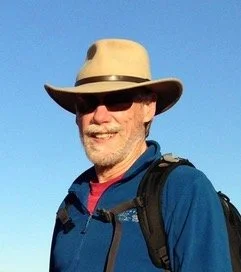
My husband Mike G. McKinnon died peacefully at home, on his own terms, eight months after a glioblastoma diagnosis. He wanted his death to be quick and without drama. Thanks to our having moved six years previously from Alaska to Oregon, it was.
Mike began having subtle dexterity and balance issues in late 2022. In January 2023, he fell on an icy sidewalk and hit his head. His general practitioner said he might have suffered a concussion but to expect gradual improvement and to proceed as planned on a 2-month trip to Tucson. We arrived there within a few days.
In following weeks, Mike continued to have a dull headache. Inexplicably, he also stumbled twice on easy hiking trails. He eventually drove to an urgent care facility, after which he reported “they treated me like a grumpy old man” and did no testing. Later, a visit to a hospital emergency room yielded diagnosis of a brain mass, likely cancerous, in his left parietal lobe. The ER doc said we should return to Oregon ASAP, but that Mike was not to fly or drive. I drove us back. Upon getting home, Mike wrote, “The most important part of the journey north [was] its magic time through sun-capped winter mountains at their most beautiful. It was perfect . . . [The scenery] and the smiles remain the high point of our run, whatever comes next.”
After operating on Mike some days later, his neurosurgeon took me aside. He said he had removed as much tumor tissue as possible but that, if he had taken more, “Mike would no longer be Mike.” I understood then that Mike’s illness was terminal. How much longer he lived would depend on whether, if at all, the tumor responded to treatments. These consisted of six weeks of radiation followed by taking chemo pills for five consecutive days each month. His body handled all the treatments well. We marveled that he had an ‘iron stomach,’ and that nothing seemed to faze him.
Then again, nothing seemed to slow the tumor’s growth either. Mike began to lose the fine motor control needed to use a keyboard. He eventually reported that it took too much mental effort to read or to do anything requiring math. He’d always been a prolific reader so this came as a big disappointment to him. About the math, not so much. However, the impending loss of nuanced analytical capability spurred feverish work by financial and legal advisors to get Mike’s estate in order.
When told in August that his treatments weren’t working, Mike requested referral to hospice. A hospice worker visited within a day and Mike asked how soon he could exercise his option under Oregon’s DWDA (Death with Dignity Act). The answer was 15 days. Fifteen days in which to twice formally declare his intent, and to be interviewed to ascertain that he was mentally capable of making his own health care decisions and that he was making his choice freely -- unaided and unpressured.
Mike could have elected at any time to postpone or rescind his decision. However, he was resolute that he wanted to proceed without delay. What cemented this feeling was that, after interviewing him, the hospice physician asked Mike if he could share something personal. He said his own father had died of a glioblastoma, in a state that did not offer the option for a medically aided death, and “You don’t want to do that to yourself!”
The doctor reminded us that a brain tumor can cause one’s functioning to go downhill rapidly. Mike immediately asked that the drugs be ordered. The doctor did so and FedEx delivered the box to our door several days later. We opened it to check that it contained three expected items: two pills plus the container of powdered ‘cocktail.’ But no, it only contained two. When the End of Life Choices Oregon (EOLCOR) volunteer checked with the doctor, he responded: “Oh. I didn’t prescribe an anxiety pill. Mike doesn’t need it.”
To the end, Mike was fully present for conversation, walks, and chuckles. His last two weeks went by quickly. It felt like we were hurtling through space. He said goodbye to friends and family, including his two sons. Most goodbyes were by phone. He made clear that, if possible, he wanted to spend his few remaining days only with me. He knew I would remain calm. Not without quiet tears – and, naturally, stunned at the swiftness of his coming end – but at least outwardly calm.
On the morning of his death, Mike took the anti-nausea pill and enjoyed one last cup of coffee. We sat together while I ate breakfast with my sister, who had arrived the night before. Afterwards we bid her goodbye, sending her off by car for a while.
Within an hour, the hospice nurse and EOLCOR volunteer arrived, and Mike and I made ourselves comfortable in chairs overlooking the cherished view from our home. The rep mixed the lethal meds and brought the concoction to Mike. He drank it and took a couple licks of popsicle. Two minutes afterward, he slipped into a deep coma.
I continued to hold his hand and talk to him, sharing memories of our life together. After about fifteen minutes, the two aides reappeared and asked how he was. I said, “You know, I think he’s gone.” They confirmed his death, called the funeral home, and departed. But not before remarking that they thought “that was the fastest [they’d] ever seen someone go.”
When two burly attendants arrived, I invited them in, then left to hike a nearby bluff and gaze out at the landscape. I didn’t want to be present while they did their bit….I didn’t want those indelible images.
Mike felt himself to be a lucky man. Lucky to have lived a good life (Mike's obituary); lucky to have the opportunity to conclude it speedily and with dignity, and, in doing so, be able to hasten his loved ones’ return to happy times and joy at life; and lucky that, years before, he had specified a much-loved island promontory in Southeast Alaska on which to have his ashes buried.
Mike and I didn’t move to Oregon because it had an assisted dying law, but we were thankful we had. In retrospect, I don’t think the elements of Mike’s death and the return of his ashes to Alaska could have come together any more smoothly or serenely.
Oregon passed its "Death with Dignity Act" in 1997. Allowing terminally ill citizens the chance to control and direct their own ends seems like something most Alaskans today can support. It is time to act and make that happen.
-- Ellen Fritts